
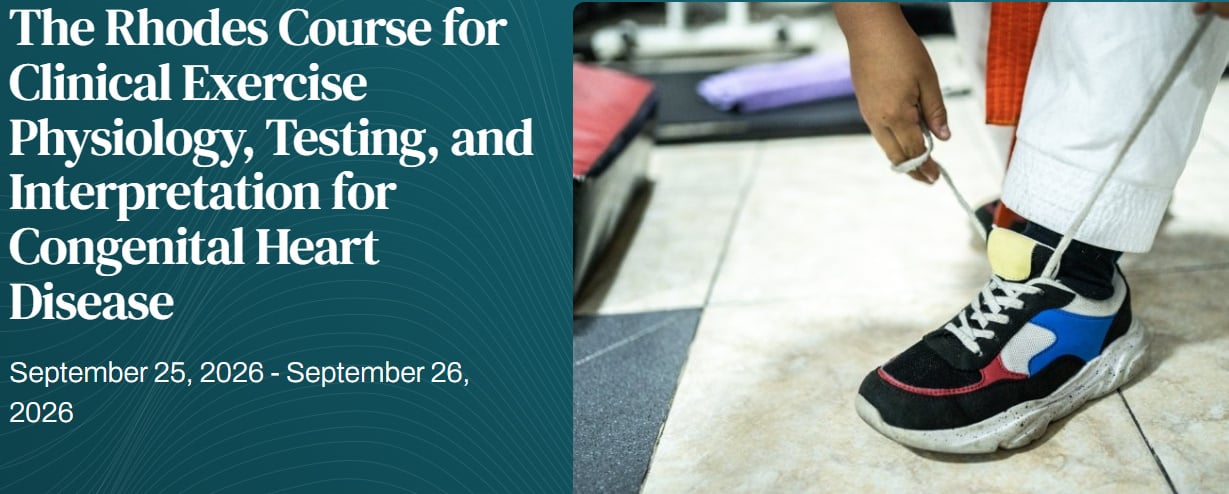
Harvard The Rhodes Course for Clinical Exercise Physiology, Testing, and Interpretation for Congenital Heart Disease 2026
$80.00
This Product is shared via google drive download link, So please share your correct Gmail id while placing the order .Please note that there are no CME points or certificate associated with this course Samples for Courses Can be found here : Free Samples Here!
Harvard The Rhodes Course for Clinical Exercise Physiology, Testing, and Interpretation for Congenital Heart Disease 2026
Harvard The Rhodes Course for Clinical Exercise Physiology, Testing, and Interpretation for Congenital Heart Disease 2026 provides specialized education in pediatric exercise physiology, cardiopulmonary exercise testing (CPET), and clinical interpretation for patients with congenital and acquired heart disease.
This focused educational program combines foundational exercise physiology with practical approaches to conducting, analyzing, and interpreting pediatric cardiopulmonary exercise tests. The course honors the legacy of Dr. Jonathan Rhodes, a pioneer in pediatric exercise cardiology and former faculty member at Boston Children’s Hospital.
Course Details
Course: The Rhodes Course for Clinical Exercise Physiology, Testing, and Interpretation for Congenital Heart Disease
Dates: September 25–26, 2026
Focus: Pediatric Exercise Physiology, Cardiopulmonary Exercise Testing (CPET), Congenital Heart Disease, and Pediatric Acquired Heart Disease
Format: Educational lectures, interactive discussions, clinical case applications, demonstrations, and hands-on learning opportunities for in-person participants
Target Audience
This course is designed for healthcare professionals involved in pediatric cardiology, exercise physiology, congenital heart disease, and clinical exercise testing, including:
- Pediatric Cardiologists
- Exercise Physiologists
- Advanced Practice Providers
- Physicians
- Physical Therapists
- Trainees
- Allied Health Professionals
- Other healthcare professionals interested in pediatric cardiopulmonary exercise testing
Program Overview
The Rhodes Course is dedicated to the science and clinical application of exercise physiology and exercise testing in children and patients with congenital heart disease (CHD) and pediatric acquired heart disease.
Participants will develop a stronger understanding of the physiological principles underlying exercise performance and learn how to conduct and interpret cardiopulmonary exercise testing (CPET) in pediatric and congenital cardiology practice.
The program uses lectures, discussions, clinical cases, demonstrations, and practical instruction to address important aspects of exercise testing, including:
- Exercise test preparation
- Appropriate testing protocol selection
- Patient motivation during testing
- Data integrity and quality
- Interpretation of CPET variables
- Evaluation of physiological limitations
- Reporting clinically meaningful findings
- Application of exercise testing results to patient management
Clinical case examples are incorporated throughout the course to demonstrate how exercise physiology and CPET findings can be translated into clinically useful information.
Pediatric Exercise Physiology and Congenital Heart Disease
Exercise capacity can provide valuable information about cardiovascular function, functional limitations, and clinical outcomes in patients with congenital heart disease.
This course emphasizes how physiological responses to exercise can be assessed and interpreted in pediatric and congenital cardiology. Participants will explore the relationship between exercise physiology, cardiovascular abnormalities, cardiopulmonary performance, and clinical decision-making.
Special attention is given to the practical challenges involved in performing exercise testing in children and patients with congenital heart disease.
Cardiopulmonary Exercise Testing (CPET)
A major component of the program focuses on the practical performance and interpretation of cardiopulmonary exercise testing.
Participants will learn how to:
- Prepare patients for CPET
- Select an appropriate exercise testing protocol
- Conduct exercise testing effectively
- Maintain reliable data collection
- Recognize important CPET variables
- Interpret physiological responses
- Identify potential exercise limitations
- Develop clinically useful reports
- Apply CPET results to congenital heart disease management
The course is designed to connect exercise physiology concepts directly with real-world clinical practice.
Clinical Case-Based Learning
Clinical case examples are used throughout the program to illustrate key concepts in pediatric exercise testing.
Cases help participants evaluate physiological impairment and understand how abnormal responses may affect:
- Exercise capacity
- Functional status
- Cardiovascular performance
- Patient health outcomes
- Clinical management decisions
The case-based approach provides practical context for interpreting CPET data rather than considering individual measurements in isolation.
Learning Objectives
Upon completion of this course, participants should be able to:
- Identify the Fundamentals of Exercise Physiology Across the Lifespan: Describe the basic principles of exercise physiology with an emphasis on patients with congenital heart disease (CHD).
- Acquire Skills to Conduct and Interpret Cardiopulmonary Exercise Testing (CPET): Acquire the ability to set up and conduct CPET, interpret key CPET variables, and effectively report findings in patients with CHD.
- Analyze Physiological Responses in CHD Patients: Use clinical case examples to evaluate physiological impairments and determine how these impairments affect a patient’s exercise capacity and health outcomes.
- Apply CPET Data to Guide Clinical Decisions: Utilize CPET insights to inform clinical management decisions for patients with congenital heart disease.
Honoring Dr. Jonathan Rhodes
The development of this course is in response to the strong demand for practical instruction in exercise assessment for pediatric and congenital heart disease populations.
The program honors the late Dr. Jonathan Rhodes, who served on the faculty at Boston Children’s Hospital and was a pioneer in pediatric exercise cardiology.
Dr. Rhodes was a friend and mentor to many pediatric exercise cardiologists around the world. His contributions continue to influence the field, and his textbook, “Exercise Physiology for the Pediatric and Congenital Cardiologist,” serves as a key reference for the course.
Who Should Participate
The program is particularly relevant for:
- Pediatric Cardiologists
- Exercise Physiologists
- Advanced Practice Providers
- Trainees
- Allied Health Professionals
- Physical Therapists
- Physicians involved in congenital heart disease care
- Healthcare professionals performing or interpreting pediatric exercise testing
Why This Course Is Relevant
Cardiopulmonary exercise testing provides important information that may not be apparent from resting cardiovascular assessment alone.
For clinicians caring for patients with congenital heart disease, understanding exercise physiology and CPET can help provide additional insight into functional capacity, physiological limitations, and clinical status.
The Rhodes Course combines foundational science with practical clinical interpretation, making it especially relevant for professionals seeking to strengthen their skills in pediatric exercise testing, congenital heart disease assessment, and CPET interpretation.
Short Description
<div style=”background:#eef8ff;border:1px solid #b9def5;border-radius:6px;padding:12px 15px;line-height:1.5;”> <strong>Harvard The Rhodes Course for Clinical Exercise Physiology, Testing, and Interpretation for Congenital Heart Disease 2026</strong> provides practical education in pediatric exercise physiology and cardiopulmonary exercise testing (CPET). Learn how to conduct and interpret exercise testing, evaluate physiological responses in congenital heart disease, analyze clinical cases, and apply CPET findings to patient management.
+ Topics:
Day 1: Friday, September 25, 2026
| Time | Topic | Speaker(s) |
| 9:30 – 10:00 am | Registration | |
| 10:00 – 10:15 am | Introduction | William Orr |
| 10:15 – 11:00 am | Approach to CPET and Congenital Heart Disease | Jesse Hansen |
| 11:00 – 11:30 am | Motivation: Science and Practice | Tracy Curran; Aimee Layton |
| 11:30 am – 12:00 pm | Motivation Large Group Workshop | Tracy Curran; Aimee Layton |
| 12:00 – 12:45 pm | Lunch | |
| 12:45 – 1:00 pm | Conducting an Exercise Test: Pearls of Wisdom | Francis Walsh |
| 1:00 – 1:30 pm | Clinical Exercise Physiology Principles | David White |
| 1:30 – 2:00 pm | Exercise Physiology in Congenital Heart Disease | Adam Powell |
| 2:00 – 3:00 pm | CPET Data Variables: Definitions and Implications | Suellen Yin |
| 3:00 – 3:15 pm | Break | |
| 3:15 – 4:00 pm | CPET Demo | William Orr; Meg Vernon |
| 4:00 – 4:15 pm | Wrap Up | Naomi Gauthier |
| 4:15 – 4:30 pm | Break | |
| 4:30 – 6:00 pm | Social Event at Museum of Science – No CME Credits Awarded |
Day 2: Saturday, September 26, 2026
| Time | Topic | Speaker(s) |
| 8:00 – 8:15 am | Breakfast | |
| 8:15 – 8:30 am | Introduction | Tracy Curran |
| 8:30 – 8:45 am | Identifying High Quality Data | Aimee Layton |
| 8:45 – 9:00 am | CPET Data Variable Review | Adam Powell |
| 9:00 – 9:45 am | CPET Data Case Study Workshop | Daniel Ziebell; Shannon O’Malley; Jennifer Huang; Arash Sabati |
| 9:45 – 10:10 am | Algorithms and Prediction Equations | William Orr |
| 10:10 – 10:20 am | Break | |
| 10:20 – 11:30 am | Case Study Workshop: Simple CHD | Daniel Ziebell; Shannon O’Malley; Jennifer Huang; Arash Sabati |
| 11:30 am – 12:00 pm | Case Study Workshop: Exercise ECGs | Kendra Ward; Suellen Yin |
| 12:00 – 1:00 pm | Lunch | |
| 1:00 – 2:15 pm | Case Study Workshop: Hemodynamic Variations in CHD | Jesse Hansen; Danielle Burstein; Meg Vernon; Jolie Britt |
| 2:15 – 2:30 pm | Break | |
| 2:30 – 3:30 pm | Case Study Workshop: Complexity, Cyanosis, and Ischemia | Jesse Hansen; Danielle Burstein; Meg Vernon; Jolie Britt |
| 3:30 – 4:00 pm | Wrap up and Summary | Naomi Gauthier |
Related products
Critical Care - Emergency medicine
Neurology / neurosurgery courses
International League Against Epilepsy 14th International Newborn Brain Conference 2023

Medical Accounts
Critical Care - Emergency medicine
Chestnet Pediatric Pulmonary Board Review On Demand 2022 ( VIDEOS)
Critical Care - Emergency medicine
Gulfcoast Pediatric Emergency and Critical Care Ultrasound 2019

Critical Care - Emergency medicine