
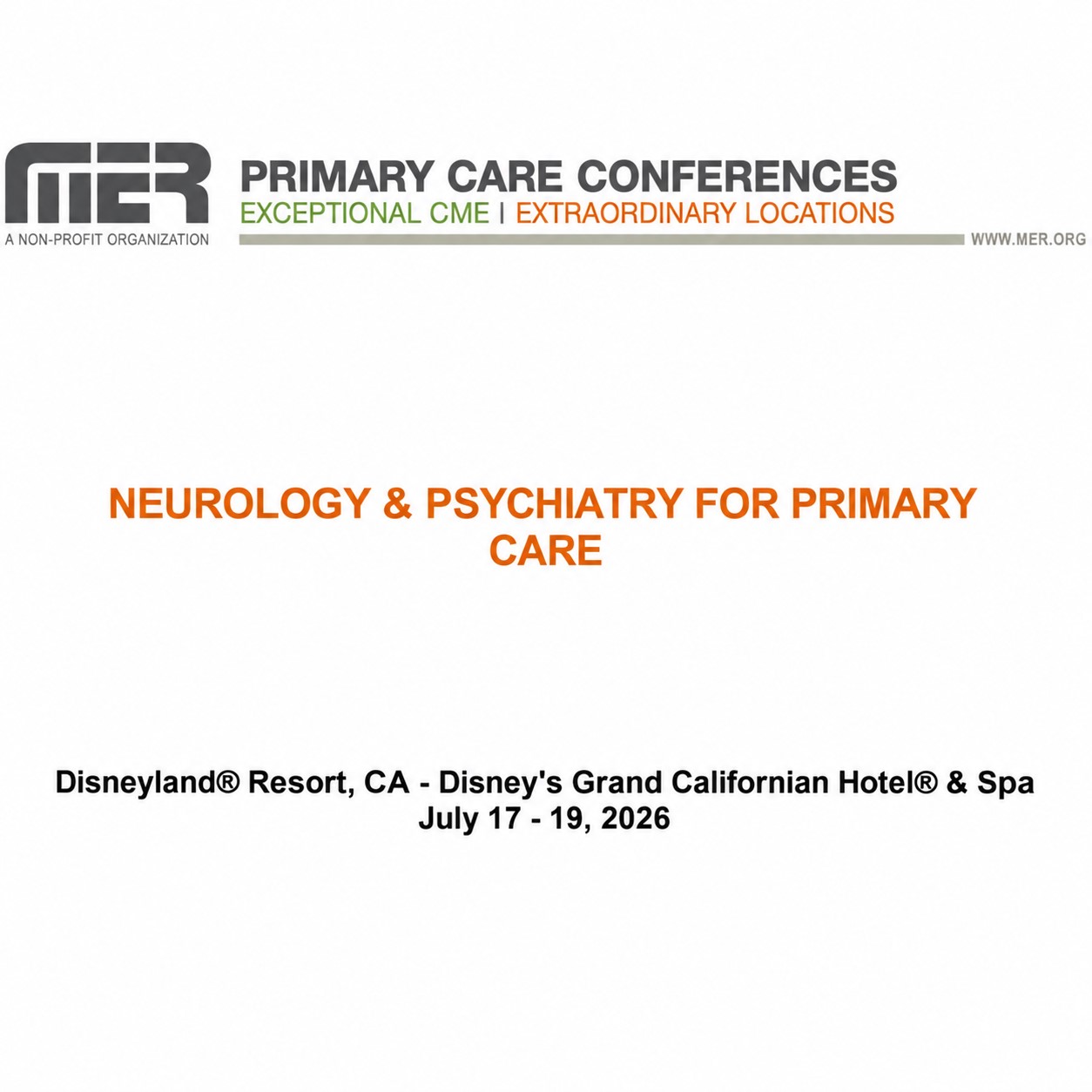
MER Primary Care Conferences Neurology & Psychiatry for Primary Care Jul 17-19, 2026
$100.00
Review neurological examination, epilepsy, cerebrovascular disease, headache, dementia and psychiatric topics from the July 17–19, 2026 MER primary care meeting.
Delivery Information: This Product is shared via google drive download link. Please use your correct Gmail address at checkout.
Please note: there are no CME points or certificate associated with this course.
Samples for Courses Can be found here: Free Samples Here!
MER Neurology & Psychiatry for Primary Care 2026
The MER Neurology & Psychiatry for Primary Care 2026 program provides a focused clinical review of common neurological and psychiatric conditions encountered in primary care practice.
Organized by Medical Education Resources (MER), the original conference was held from July 17–19, 2026, at Disney’s Grand Californian Hotel & Spa at the Disneyland Resort in California.
The curriculum combines practical neurology with evidence-based psychiatric medicine, covering neurological examination, seizures, antiepileptic medications, cerebrovascular disorders, weakness, migraine, Alzheimer’s disease, Parkinson’s disease, movement disorders, ADHD, anxiety disorders, bipolar disorder, and comprehensive psychiatric assessment.
The program is particularly relevant to primary care clinicians who frequently evaluate patients with neurological symptoms, cognitive disorders, headaches, movement abnormalities, mood disorders, anxiety, or attention-related conditions.
Course Details
The topic overview refers to the original meeting, using the official MER agenda dated January 23, 2026 as a reference. Credit figures below describe the original live event, not this store product. Purchase does not include CME points, a certificate, conference registration or a publisher account. The agenda does not establish the completeness or format of the delivered files.
- Provider: Medical Education Resources (MER)
- Official Course: Neurology & Psychiatry for Primary Care
- Year: 2026
- Original Conference Dates: July 17–19, 2026
- Original Venue: Disney’s Grand Californian Hotel & Spa
- Location: Disneyland Resort, California, USA
- Original MER Listing: 12 Credit Hours
- Original ANCC Listing: 5.25 Pharmacotherapeutic Contact Hours
- Specialties: Neurology, Psychiatry, Internal Medicine & Primary Care
- Focus: Evidence-Based Neurological and Psychiatric Medicine
Who Should Attend?
This program is targeted to office-based primary care providers and other healthcare professionals seeking clinically relevant updates in neurological and psychiatric medicine.
Best For
- Primary Care Physicians
- Internal Medicine Physicians
- Family Medicine Physicians
- Neurologists
- Psychiatrists
- Nurse Practitioners
- Physician Assistants
- Other clinicians evaluating neurological and psychiatric conditions
Neurology
Neurological Examination
Develop a practical and structured approach to performing the neurological examination.
Important areas include:
- Mental status
- Cranial nerves
- Motor examination
- Sensory examination
- Reflexes
- Coordination
- Gait
- Neurologic localization
- Recognition of abnormal findings
A systematic neurological examination can help primary care clinicians determine whether symptoms require additional diagnostic evaluation or specialist referral.
Seizures & Epilepsy
Differential Diagnosis of Seizures
Review the evaluation of patients presenting with possible seizure activity.
Topics include:
- Clinical history
- Witness descriptions
- Seizure classification
- Differential diagnosis
- Syncope versus seizure
- Provoked versus unprovoked seizures
- Neurologic assessment
- Diagnostic considerations
Antiepileptic Medications
Compare important clinical characteristics of antiepileptic medications including:
- Mechanisms of action
- Clinical pharmacology
- Adverse-effect profiles
- Patient-specific considerations
- Medication selection
- Drug interactions
- Treatment monitoring
The goal is to help clinicians understand how pharmacological characteristics influence medication selection in patients with seizure disorders.
Cerebrovascular Disorders
Review current approaches to prevention and treatment of cerebrovascular disease.
Topics include:
- Stroke risk factors
- Primary prevention
- Secondary prevention
- Hypertension management
- Lipid management
- Antithrombotic considerations
- Recognition of stroke symptoms
- TIA
- Cerebrovascular risk reduction
Weakness
Learn how to distinguish true neurological weakness from nonspecific symptoms such as:
- Fatigue
- Generalized tiredness
- Pain-limited movement
- Functional symptoms
Clinical evaluation includes:
- Patient history
- Motor examination
- Neurologic localization
- Reflex testing
- Pattern recognition
- Appropriate diagnostic evaluation
Migraine & Headache Disorders
Review the differential diagnosis and management of migraine headaches.
Topics include:
- Migraine recognition
- Headache history
- Differential diagnosis
- Migraine with and without aura
- Acute treatment
- Preventive treatment
- Trigger management
- Warning signs for secondary headache
- Referral considerations
Alzheimer’s Disease
Review evidence-based approaches to assessment and management of Alzheimer’s disease.
Topics include:
- Cognitive symptoms
- Clinical recognition
- Cognitive assessment
- Differential diagnosis
- Diagnostic evaluation
- Pharmacologic management
- Non-pharmacologic management
- Caregiver considerations
- Long-term patient management
Parkinson’s Disease & Movement Disorders
Develop a structured approach to patients presenting with weakness, tremor, or abnormal movement.
Topics include:
- Parkinson’s disease
- Cardinal motor features
- Bradykinesia
- Rigidity
- Tremor
- Gait abnormalities
- Other movement disorders
- Differential diagnosis
- Referral considerations
Psychiatry
Comprehensive Psychiatric Assessment
Review a structured approach to evaluating patients with psychiatric presentations.
Key components include:
- Presenting symptoms
- Psychiatric history
- Medical history
- Medication history
- Mental status examination
- Substance-use assessment
- Functional assessment
- Safety assessment
- Differential diagnosis
ADHD
Review pharmacologic treatment options for attention-deficit/hyperactivity disorder.
Topics include:
- ADHD diagnosis
- Patient assessment
- Stimulant medications
- Non-stimulant medications
- Clinical pharmacology
- Adverse-effect profiles
- Treatment selection
- Monitoring
The program emphasizes comparison of treatment benefits and potential adverse effects when selecting therapy.
Digital Media and Mental Health
The agenda also includes a session on mental-health challenges associated with digital and social media.
Anxiety Disorders
Review current evidence surrounding the management of anxiety disorders.
Topics may include:
- Generalized anxiety disorder
- Panic symptoms
- Clinical assessment
- Differential diagnosis
- Pharmacologic treatment
- Psychotherapeutic approaches
- Long-term management
Bipolar Disorder
Review evidence-based approaches to bipolar disorder.
Topics include:
- Bipolar disorder recognition
- Mood episodes
- Differential diagnosis
- Mood-stabilizing medications
- Psychosocial interventions
- Pharmacologic treatment
- Psychiatric comorbidities
- Long-term management considerations
Learning Objectives
Upon completion of this program, participants should be better able to:
- Perform a structured neurological examination.
- Explain the differential diagnosis of seizures.
- Compare the adverse-effect and clinical pharmacology profiles of antiepileptic medications.
- Utilize prevention and treatment strategies for cerebrovascular disorders.
- Compare the benefits and adverse-effect profiles of pharmacologic treatment options for ADHD.
- Utilize a comprehensive assessment to identify and diagnose patients presenting with psychiatric symptoms.
- Review current evidence for treatment of anxiety disorders.
- Discuss psychosocial and pharmacologic mood-stabilizing treatments for bipolar disorder.
- Recognize common psychiatric comorbidities associated with bipolar disorder.
- Utilize history and physical examination to distinguish neurological weakness from nonspecific symptoms.
- Describe the differential diagnosis and treatment options for migraine headaches.
- Discuss evidence-based management options for Alzheimer’s disease.
- Evaluate patients presenting with weakness.
- Recognize cardinal clinical features of Parkinson’s disease.
- Differentiate Parkinson’s disease from other movement disorders.
- Integrate neurological and psychiatric assessment into primary care clinical decision-making.
Related products
Critical Care - Emergency medicine
Critical Care - Emergency medicine

Critical Care - Emergency medicine

Critical Care - Emergency medicine
2022 ISICEM International Symposium on Intensive Care & Emergency Medicine

Pediatrics

Medical Accounts

Critical Care - Emergency medicine

Critical Care - Emergency medicine
40th ISICEM International Symposium on Intensive Care & Emergency Medicine 2021