
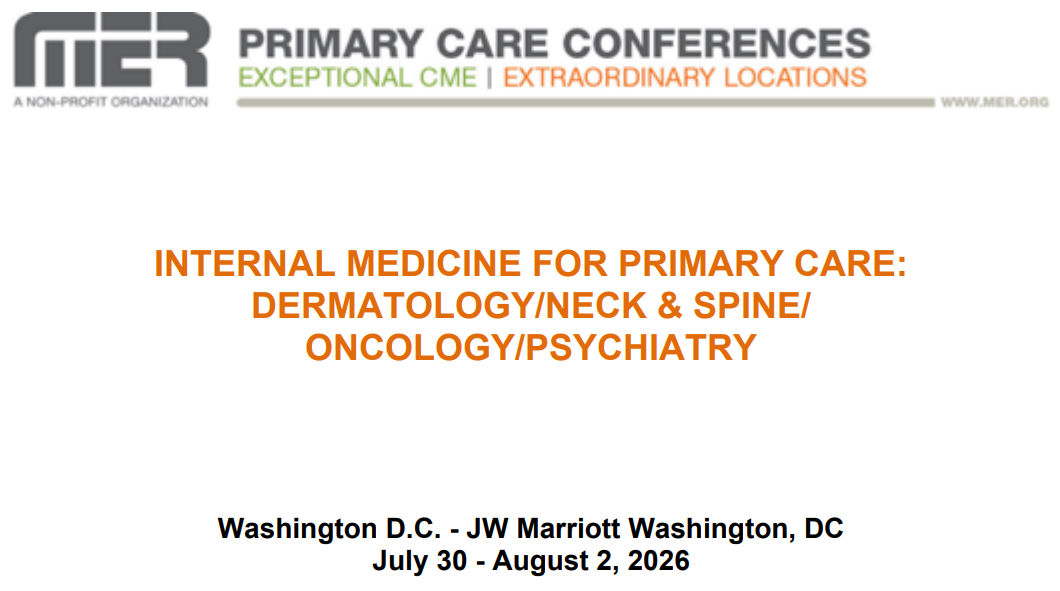
MER Primary Care Conferences Internal Medicine for Primary Care Derm Neck & Spine Onc Psych Jul 30 – Aug 02, 2026
$130.00
This Product is shared via google drive download link, So please share your correct Gmail id while placing the order .Please note that there are no CME points or certificate associated with this course Samples for Courses Can be found here : Free Samples Here!
MER Internal Medicine for Primary Care: Dermatology, Neck & Spine, Oncology & Psychiatry 2026
Primary Care CME Review – Dermatology, Neck & Spine, Oncology & Psychiatry
The MER Internal Medicine for Primary Care: Dermatology, Neck & Spine, Oncology & Psychiatry 2026 program provides a multidisciplinary review of important clinical topics commonly encountered by primary care physicians and other healthcare professionals.
Originally presented by Medical Education Resources (MER) at the JW Marriott Washington, DC, from July 30 to August 2, 2026, the program focuses on practical approaches to diagnosis, treatment, prevention, and long-term management across dermatology, oncology, psychiatry, and musculoskeletal medicine.
The curriculum is particularly useful for physicians seeking practical updates in skin disorders, cancer prevention and survivorship, psychiatric conditions, cervical and lumbar spine disorders, and other frequently encountered primary care problems.
Course Details
- Course: Internal Medicine for Primary Care: Dermatology/Neck & Spine/Oncology/Psychiatry
- Provider: Medical Education Resources (MER)
- Year: 2026
- Dates: July 30 – August 2, 2026
- Location: JW Marriott Washington, DC
- Specialties: Internal Medicine, Primary Care, Dermatology, Oncology, Psychiatry, Neck & Spine
- Format: Medical education / primary care review
Who Should Attend?
This program is targeted toward office-based primary care providers and other healthcare professionals seeking clinically relevant updates in primary care medicine.
Best For
- Primary Care Physicians
- Internal Medicine Physicians
- Family Medicine Physicians
- Dermatologists
- Oncologists
- Psychiatrists
- Orthopedic Physicians
- Spine Specialists
- Nurse Practitioners
- Physician Assistants
- Other healthcare professionals involved in primary care
Psychiatry
ADHD
Review commonly used pharmacologic treatment options for attention-deficit/hyperactivity disorder and compare their:
- Clinical benefits
- Potential adverse effects
- Treatment considerations
- Appropriate use in clinical practice
Bipolar Disorder
Review:
- Mood-stabilizing pharmacologic treatments
- Psychosocial management strategies
- Common psychiatric comorbidities
- Appropriate treatment approaches
Depression
Explore evidence-based approaches to depression management, including:
- Pharmacologic therapy
- Non-pharmacologic treatment
- Patient-centered treatment selection
- Long-term management strategies
Substance Use Disorders
Develop strategies for:
- Identifying substance use disorders
- Clinical screening
- Patient assessment
- Treatment selection
- Long-term management
Oncology
Cancer Prevention
Review clinical practices and preventive strategies demonstrated to reduce cancer risk.
Topics include:
- Cancer risk assessment
- Prevention strategies
- Screening considerations
- Patient counseling
Diagnostic Approach to Suspected Cancer
Develop a practical approach to patients presenting with findings that may indicate malignancy.
Review:
- Clinical evaluation
- Appropriate diagnostic testing
- Risk assessment
- Referral considerations
Cancer Survivorship
Understand important considerations when caring for cancer survivors, including:
- Long-term complications
- Recurrence risks
- Surveillance
- Treatment-related health issues
- Primary care management
Oral Anticoagulants
Review practical considerations for managing patients receiving newer oral anticoagulant therapies.
Dermatology
Dermatitis
Differentiate between common presentations and causes of:
- Atopic dermatitis
- Irritant contact dermatitis
- Allergic contact dermatitis
- Nummular dermatitis
Review clinical features, differential diagnosis, and treatment approaches.
Papulosquamous Disorders
Review diagnostic principles and treatment options for diseases presenting with:
- Red lesions
- Raised lesions
- Scaling
- Papules and plaques
Benign and Malignant Skin Tumors
Learn how to differentiate common benign lesions from potentially malignant skin tumors and determine when additional evaluation or office-based procedures may be appropriate.
Skin Cancer Detection
Improve recognition of:
- Precancerous skin lesions
- Suspicious pigmented lesions
- Common skin cancers
- Clinical warning signs requiring biopsy or specialist referral
Neck & Spine
Lumbar Spine Disorders
Review practical approaches to:
- Evaluating low back pain
- Identifying lumbar spine disorders
- Differential diagnosis
- Initial treatment
- Early management strategies
Abnormal Gait
Develop an approach to evaluating abnormal gait patterns and identifying possible underlying neurologic or musculoskeletal causes.
Cervical Spine Disorders
Learn how to use:
- Observation
- Palpation
- Range-of-motion testing
- Neurologic examination
to evaluate patients with suspected cervical spine disorders.
Cervical Spine Range of Motion
Review practical techniques for evaluating cervical spine mobility and recognizing abnormal findings.
Learning Objectives
Upon completion of this program, participants should be better able to:
- Compare the benefits and side effect profiles of pharmacologic treatment options for ADHD.
- Discuss mood-stabilizing psychosocial and pharmacologic treatments for bipolar disorder and frequently associated psychiatric conditions.
- Recommend appropriate pharmacologic and non-pharmacologic treatments for depression.
- Describe strategies for identifying and treating substance use disorders.
- Identify clinical practices shown to help prevent cancer.
- Discuss the diagnostic approach to patients with suspected cancer.
- Evaluate and manage important health risks affecting cancer survivors.
- Manage patients receiving newer oral anticoagulants.
- Differentiate atopic, irritant contact, allergic contact, and nummular dermatitis.
- Discuss diagnostic principles and treatment options for common papulosquamous diseases.
- Differentiate benign and malignant skin tumors and recognize appropriate office-based management strategies.
- Identify precancerous and cancerous skin lesions.
- Identify early treatment options for lumbar spine disorders.
- Evaluate abnormal gait patterns.
- Utilize observation, palpation, range-of-motion assessment, and neurologic examination when evaluating cervical spine disorders.
- Evaluate cervical spine range of motion.
Major Clinical Areas
- Internal Medicine
- Primary Care Medicine
- Dermatology
- Skin Cancer
- Dermatitis
- Papulosquamous Disorders
- Oncology
- Cancer Prevention
- Cancer Diagnosis
- Cancer Survivorship
- Psychiatry
- ADHD
- Bipolar Disorder
- Depression
- Substance Use Disorders
- Neck & Spine Medicine
- Cervical Spine Disorders
- Lumbar Spine Disorders
- Musculoskeletal Examination
- Abnormal Gait
- Oral Anticoagulant Management
Why This Course Is Valuable
The MER Internal Medicine for Primary Care Dermatology, Neck & Spine, Oncology & Psychiatry 2026 program brings together four major areas frequently encountered in primary care.
Its multidisciplinary curriculum helps clinicians strengthen practical skills in dermatologic diagnosis, cancer prevention and survivorship, psychiatric disease management, and evaluation of cervical and lumbar spine disorders.
The course is particularly suitable for clinicians looking for a broad 2026 primary care review with practical, clinically focused material applicable to everyday patient care.
4. Short Description
The MER Internal Medicine for Primary Care: Dermatology, Neck & Spine, Oncology & Psychiatry 2026 course provides practical updates for primary care clinicians covering dermatologic disorders, skin cancer, cancer prevention and survivorship, ADHD, bipolar disorder, depression, substance use disorders, and cervical and lumbar spine conditions. Originally held July 30 – August 2, 2026, at the JW Marriott Washington, DC.
Topics
Thursday, July 30, 2026
-
The Complexity of Adult ADHD (Psychiatry): ADHD in adults with an emphasis on symptom identification; Co-occurring conditions; Psychiatric and medical differential diagnosis; evidence-based and FDA approved pharmacological treatments.
-
Bipolar Spectrum Disorders (Psychiatry): Bipolar spectrum disorders in adults as compared to youth; Comprehensive history-taking; Differential diagnosis; Co-occurring psychiatric and medical conditions; Phase specific treatment considerations and interventions.
-
Depressive Disorders (Psychiatry): History taking, diagnosis and treatment of depression across the lifespan; pharmacologic and non-pharmacologic treatment options; rational polypharmacy.
-
Cancer Prevention (Oncology): Cancer screening and clinical practices shown to prevent cancer will be reviewed.
-
Approach to the Patient with Suspected Cancer (Oncology): Symptoms, signs and diagnoses that raise the suspicion of cancer will be reviewed, and an approach to evaluating these patients will be presented.
Friday, July 31, 2026
-
Management of Cancer Survivors (Oncology): Medical issues related to cancer survivorship and approaches to surveillance for cancer recurrence will be reviewed.
-
A Primary Care Review of New Oral Anticoagulants (Oncology): Mechanisms of action, clinical indications, therapeutic indices, perioperative management and approaches to reversal of new anticoagulant and antiplatelet medications will be reviewed.
-
Substance Use Disorders (Psychiatry): Substance abuse history-taking to encourage patient honesty; Accurate diagnosis; Use of screening tools; Brief intervention; Recovery and treatment options; Motivational interviewing; Family symptoms and codependency.
-
Dermatitis (Dermatology): Overview of the causes and forms of skin irritants; Contact, atopic, irritant, nummular, seborrheic and exfoliative; Treatment of blistering, oozing, crusting and flaking; Diagnostic principles and management strategies.
-
Papulosquamous Diseases (Dermatology): Diagnostic principles of skin lesions consisting of red or purple papules; Psoriasis, lichen planus, pityriasis rosea, lupus erythematosus; Discussion of how to tell one scaly rash from another.
Saturday, August 1, 2026
-
Benign Skin Tumors (Dermatology): Proper diagnosis and treatment of common benign tumors; Biopsies and histopathologic examination; Nevi, seborrheic keratosis keloids, hemangiomas and miscellaneous tumors; When to refer.
-
Premalignant and Malignant Skin Tumors (Dermatology): Recognition of precursors of malignancies; Excisional and punch biopsies; Actinic keratosis, Bowen’s disease, squamous cell carcinoma, basal cell carcinoma, melanoma and other selected tumors; Risk reduction education.
-
Diagnosis and Treatment of Lumbar Spine Disorders (Neck & Spine): A practical approach to the diagnosis and early management of lumbar spine disorders will be presented. Anatomy, differential diagnosis, as well as physical examination concepts will be covered.
-
Physical Examination of the Lumbar Spine, Hip, and Sacroiliac Joint (Neck & Spine): Exam techniques will be demonstrated and discussed.
Sunday, August 2, 2026
-
Diagnosis and Treatment of Cervical Spine and Select Upper Extremity Disorders (Neck & Spine): A practical approach to the diagnosis and early management of cervical spine and selected upper extremity disorders will be presented. Anatomy, differential diagnosis, as well as physical examination concepts will be covered.
-
Physical Examination of the Cervical Spine and UE Entrapment Neuropathies (Neck & Spine): Exam techniques will be demonstrated and discussed.
Related products

Anesthesiology & pain medicine

Critical Care - Emergency medicine
Critical Care - Emergency medicine

Internal Medicine

Critical Care - Emergency medicine

Critical Care - Emergency medicine

Critical Care - Emergency medicine

USMLE / kaplan and Board Review
Uworld USMLE COMLEX Level 1 Qbank, Updated Jan 2023, System- and Subject-wise (PDF)