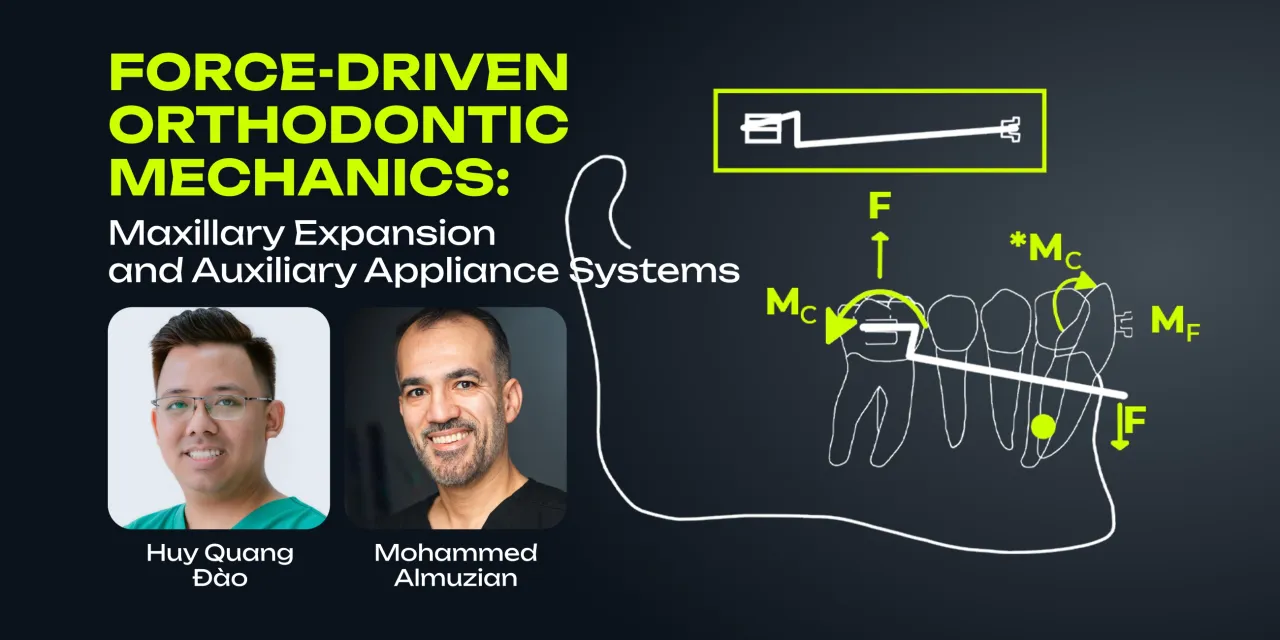
OHI-S Force-Driven Orthodontic Mechanics Maxillary Expansion and Auxiliary Appliance Systems 6 lessons 3h 24min

$35.00
This Product is shared via google drive download link, So please share your correct Gmail id while placing the order .Please note that there are no CME points or certificate associated with this course Samples for Courses Can be found here : Free Samples Here!
OHI-S Force-Driven Orthodontic Mechanics
Maxillary Expansion & Auxiliary Appliance Systems
6 Lessons | 3 Hours 24 Minutes | 2.75 CE Credits
Build a deeper understanding of force-driven orthodontic biomechanics, maxillary expansion, transverse correction, and auxiliary appliance design with OHI-S Force-Driven Orthodontic Mechanics: Maxillary Expansion and Auxiliary Appliance Systems.
Presented by Mohammed (Mo) Almuzian and Huy Quang Đào, this clinically oriented orthodontic course connects classical biomechanical principles with modern appliance design and evidence-informed treatment planning.
The program focuses on:
- Rapid Maxillary Expansion – RME
- Maxillary transverse deficiency
- Growing-patient expansion
- Adult maxillary expansion
- CAD/CAM RME appliances
- RME design and bonding
- Expansion activation protocols
- Class III expansion strategies
- Transpalatal arches – TPA
- Quad helix appliances
- Nance appliances
- Maxillary segmental distalization
- Ricketts utility sectional arch
- Center of resistance
- Force vectors
- Class II elastics
- Third-order bends
- Miniscrew-supported mechanics
- Anchorage control
- Compensatory bends
- Side-effect management
The central biomechanical framework is:
Define the Treatment Goal → Identify the Required Force System → Locate the Center of Resistance → Select Anchorage → Design the Appliance → Activate → Monitor Desired and Undesired Effects
Course Details
- Course: Force-Driven Orthodontic Mechanics: Maxillary Expansion and Auxiliary Appliance Systems
- Provider: OHI-S
- Faculty: Mohammed (Mo) Almuzian, Huy Quang Đào
- Lessons: 6
- Official Duration: 3 Hours 24 Minutes
- Language: English
- Official OHI-S CE: 2.75 CE Credits
- Primary Specialty: Orthodontics
- Level: Intermediate to Advanced Orthodontic Biomechanics
- Main Focus: Maxillary Expansion & Auxiliary Appliance Mechanics
Course Overview
Successful orthodontic treatment requires more than knowing which appliance is traditionally used for a particular malocclusion.
The clinician must understand:
- What movement is required?
- Which force system can produce it?
- Where is the center of resistance?
- What will act as the anchorage unit?
- Which side effects are likely?
- How can those side effects be controlled?
This course applies those questions to some of the most important auxiliary systems in orthodontics.
Force-Driven Orthodontics
A force-driven approach begins with biomechanics rather than appliance selection.
Instead of asking:
“Which appliance should I use?”
the clinician first asks:
“What force and moment system do I need?”
Then the appliance is designed around the required movement.
A useful sequence is:
Diagnosis
↓
Treatment Objective
↓
Required Tooth/Skeletal Movement
↓
Force Vector
↓
Center of Resistance
↓
Anchorage Requirement
↓
Appliance Design
↓
Activation
↓
Side-Effect Control
Orthodontic Force Systems
Every active orthodontic appliance produces:
- Desired effects
- Reactive effects
- Potential unwanted movement
Understanding the complete force system allows clinicians to anticipate what happens not only to the target teeth but also to the anchorage unit.
This is particularly important when using:
- Expanders
- Transpalatal arches
- Quad helices
- Utility arches
- Elastics
- Miniscrews
MAXILLARY EXPANSION
Maxillary expansion is one of the major themes of the course.
Treatment planning requires differentiation between:
- Dental expansion
- Dentoalveolar expansion
- Skeletal expansion
and consideration of:
- Patient age
- Dental development
- Skeletal maturity
- Amount of transverse deficiency
- Periodontal limits
- Appliance design
Rapid Maxillary Expansion – RME
RME is used in selected patients to address transverse maxillary deficiency.
The course reviews:
- Biological principles
- Historical development
- Appliance design
- Bonding
- Banding
- Activation
- Timing
- Clinical customization
The emphasis is on selecting an expansion protocol according to the patient rather than using one activation sequence universally.
LESSON 1
Maxillary Expanders: History and Clinical Use
Faculty: Mohammed (Mo) Almuzian
Duration: 30 Minutes
The first lesson establishes the foundation of maxillary expansion.
Topics include:
- Historical development of maxillary expanders
- Classical expansion concepts
- Modern expansion concepts
- Clinical principles of maxillary expansion
- Theoretical principles
- Determining how much expansion is required
- RME mechanisms of action
- Expander design characteristics
- Evidence for different protocols
- Appliance customization
- Clinical application
How Much Expansion Is Required?
The goal should not simply be:
“Make the Maxilla Wider.”
Treatment planning should define:
- Existing transverse discrepancy
- Desired arch relationship
- Dental compensation
- Crossbite
- Skeletal contribution
- Final occlusal objective
The amount of expansion should therefore be clinically justified.
Dental vs. Skeletal Effects
Expansion appliances can produce combinations of:
Skeletal Effects
Changes involving the maxillary skeletal complex.
Dental Effects
Movement or tipping of teeth.
Dentoalveolar Effects
Changes involving both teeth and supporting alveolar structures.
The proportions of these effects can vary according to:
- Patient maturity
- Appliance design
- Force system
- Activation protocol
RME Appliance Design
The design of an expander can influence:
- Force delivery
- Dental support
- Skeletal effect
- Hygiene
- Patient comfort
- Clinical control
The course therefore emphasizes customizing appliance design rather than treating all RME devices as biomechanically identical.
Evidence-Based Expansion
The first lesson reviews available evidence surrounding different expansion protocols.
The key principle is:
Protocol Selection Should Follow Diagnosis, Biology, and Evidence
rather than habit alone.
LESSON 2
Design, Bonding Protocols, and Activation Protocols for Rapid Maxillary Expansion
Faculty: Mohammed (Mo) Almuzian
Duration: 42 Minutes
This lesson moves from expansion theory into detailed clinical execution.
Topics include:
- RME design options
- CAD/CAM RME
- Bonded expanders
- Banded expanders
- Bonding protocols
- Banding protocols
- Activation schedules
- Class III cases
- Expansion timing
- Dental development
- Clinical case analysis
- Individualized treatment planning
Bonded vs. Banded RME
Different RME designs produce different practical and biomechanical considerations.
The clinician may need to evaluate:
- Tooth support
- Occlusion
- Vertical effects
- Appliance retention
- Hygiene
- Treatment objective
The choice should be case-specific.
CAD/CAM RME
The course includes modern CAD/CAM rapid maxillary expander workflows.
Digital fabrication can support:
- Appliance customization
- Reproducibility
- Digital design
- Integration with modern orthodontic workflows
However, digital manufacturing does not remove the need to understand the underlying biomechanics.
Activation Protocols
RME activation is not simply a mechanical instruction.
The activation protocol influences:
- Rate of force application
- Tissue response
- Dental effects
- Skeletal effects
- Patient experience
Protocols should account for:
- Age
- Maturity
- Appliance design
- Treatment objective
Timing of Maxillary Expansion
Timing is particularly important.
The course examines treatment according to:
- Chronological age
- Dental development
- Patient growth
The clinical question is:
When Is the Most Appropriate Time to Expand This Patient?
rather than assuming identical treatment at all ages.
RME in Class III Malocclusion
The official curriculum specifically includes expansion protocols for Class III malocclusion.
In selected growing patients, transverse correction may form part of a broader Class III treatment strategy.
The clinician should integrate expansion with:
- Sagittal diagnosis
- Growth
- Occlusal relationships
- Overall treatment objectives
LESSON 3
Adult Expansion and Risks: Controversies and Updates in Maxillary Expansion
Faculty: Mohammed (Mo) Almuzian
Duration: 32 Minutes
Adult expansion requires a different clinical mindset from routine expansion in growing patients.
This lesson reviews:
- Adult maxillary expansion
- Skeletal maturity
- Clinical challenges
- Risks and complications
- Current research
- Areas of controversy
- Differing clinical viewpoints
- Risk-reduction strategies
- Patient selection
Why Adult Expansion Is Different
Skeletal maturation alters the biological environment for expansion.
Therefore, protocols used successfully in younger patients should not automatically be transferred to adults.
The clinician must consider:
- Skeletal maturity
- Periodontal anatomy
- Dental tipping
- Alveolar limitations
- Treatment objective
- Alternative treatment strategies
Adult Expansion Risks
The official OHI-S curriculum specifically emphasizes risks and complications.
These may be influenced by:
- Patient anatomy
- Skeletal maturity
- Force magnitude
- Appliance design
- Periodontal boundaries
This makes adult maxillary expansion risks an important educational topic rather than simply promoting expansion in all adult patients.
Controversies in Adult Expansion
Adult maxillary expansion remains an area where treatment philosophies and techniques may differ.
The course reviews:
- Current research
- Updated clinical concepts
- Different professional viewpoints
This is important because no single protocol should be marketed as universally appropriate for every adult transverse deficiency.
Risk Mitigation
A safer decision framework is:
Diagnose the Transverse Problem
↓
Evaluate Maturity and Periodontal Limits
↓
Determine the Desired Dental vs. Skeletal Effect
↓
Assess Risks
↓
Select the Most Appropriate Expansion Strategy
LESSON 4
Transpalatal Arches, Quad Helices, and Nance Appliances: Modern Orthodontic Tools
Faculty: Mohammed (Mo) Almuzian
Duration: 24 Minutes
This lesson examines three classic orthodontic auxiliary systems:
- Transpalatal Arch – TPA
- Quad Helix
- Nance Appliance
Topics include:
- Functional roles
- Appliance biomechanics
- Advantages
- Disadvantages
- Indications
- Contraindications
- Design variations
- Customization
- Case selection
- Integration into comprehensive orthodontic treatment
Transpalatal Arch – TPA
The TPA is a versatile maxillary auxiliary appliance.
Potential biomechanical roles may include:
- Anchorage control
- Transverse control
- Molar rotation
- Molar-position management
- Arch coordination
Its exact function depends on how it is designed and activated.
Quad Helix
The quad helix is commonly associated with transverse dentoalveolar correction.
Its spring design allows controlled force delivery.
Clinical use requires understanding of:
- Activation
- Force level
- Dental effects
- Anchorage
- Side effects
Nance Appliance
The Nance appliance is frequently used for anchorage in the maxillary arch.
The course compares it with other auxiliary systems to help clinicians decide:
Which Appliance Best Matches the Required Anchorage and Force System?
TPA vs. Quad Helix vs. Nance
These appliances are not interchangeable.
TPA
Strong for selected molar and transverse-control mechanics.
Quad Helix
Useful for selected expansion and transverse corrections.
Nance
Often used primarily as a maxillary anchorage appliance.
Clinical selection depends on the intended biomechanical role.
Indications & Contraindications
Rather than teaching appliances as universal solutions, the course reviews:
- When each appliance can help
- When another appliance may be more appropriate
- Potential disadvantages
- Expected side effects
This is a major strength of the force-driven approach.
LESSON 5
Segmental Distalization of the Maxilla Using Ricketts Utility Sectional Arch
Faculty: Huy Quang Đào
Duration: 32 Minutes
This lesson moves into more advanced force-system design.
Topics include:
- Segmental maxillary distalization
- Force vectors
- Center of resistance
- Distalization biomechanics
- Side effects
- Ricketts utility sectional arch
- Class II elastics
- Third-order bends
- Miniscrews
- Anchorage
- Wire bending
- Appliance fabrication
- Correction of unwanted effects
Segmental Maxillary Distalization
Segmental mechanics allow clinicians to isolate active and reactive units more deliberately.
The objective is to control:
- Which teeth move
- Direction of movement
- Anchorage
- Side effects
rather than treating the entire arch as one mechanically inseparable unit.
Center of Resistance
Understanding the center of resistance is fundamental to force-driven orthodontics.
If force is applied at different relationships to the center of resistance, the resulting movement may involve different combinations of:
- Translation
- Rotation
- Tipping
Therefore:
Force Direction + Point of Application
are as important as force magnitude.
Force Vectors
The course analyzes force vectors during distalization.
A force should be considered in terms of:
- Magnitude
- Direction
- Point of application
The resulting system must be evaluated for both:
Desired Movement
and:
Unwanted Side Effects
Ricketts Utility Sectional Arch
A major part of Lessons 5 and 6 is the Ricketts utility sectional arch.
The curriculum includes:
- Appliance design
- Wire selection concepts
- Bending
- Fabrication
- Activation
- Anchorage
- Side-effect correction
This makes Ricketts Utility Arch Course an important secondary SEO keyword.
Step-by-Step Wire Bending
OHI-S specifically includes video demonstrations of:
- Wire bending
- Ricketts utility sectional arch fabrication
This gives the program a practical laboratory/clinical component beyond theoretical biomechanics.
Class II Elastics
Lesson 5 includes distalization mechanics combined with:
Class II Elastics
The clinician must understand that intermaxillary elastics create reciprocal effects that may influence:
- Incisor position
- Molar position
- Vertical relationships
- Anchorage
Third-Order Bends
The official curriculum includes third-order bends as part of the distalization system.
Third-order control contributes to management of:
- Torque
- Root position
- Tooth inclination
within the overall force system.
Miniscrew-Supported Mechanics
The Ricketts utility sectional arch is also demonstrated in combination with miniscrews.
Skeletal anchorage can modify the reactive component of the force system and reduce dependence on dental anchorage in selected cases.
Side Effects of Distalization
No orthodontic force system is completely isolated.
Possible unwanted effects should be anticipated during treatment.
The course specifically teaches:
Analyze Side Effects → Identify Their Mechanical Cause → Apply Corrective Mechanics
LESSON 6
Activation Protocols and Clinical Applications of the Ricketts Utility Arch
Faculty: Huy Quang Đào
Duration: 41 Minutes
The final lesson focuses on detailed activation and clinical application.
Topics include:
- Activation components
- Ricketts utility sectional arch
- Anchorage mechanics
- Toe-in bends
- Inclination control
- Angulation control
- Compensatory bends
- Intermaxillary elastics
- Clinical case analysis
Activation Protocols
A utility arch does not produce a single fixed force system.
Changes in:
- Bend location
- Bend magnitude
- Wire geometry
- Anchorage
can substantially alter the clinical effect.
Therefore, activation should be planned according to a defined biomechanical objective.
Toe-In Activation
The official program includes anchorage control using a toe-in activation bend.
This illustrates a core biomechanical principle:
Small Wire Modifications Can Produce Significant Changes in Tooth Movement
when they alter the generated moment and force system.
Angulation & Inclination Control
Orthodontic movement must be considered in three dimensions.
The course discusses compensatory bends for management of:
- Tooth angulation
- Tooth inclination
rather than focusing only on anteroposterior movement.
Compensatory Mechanics
Unwanted effects should not simply be accepted as an unavoidable part of treatment.
Instead:
Predict → Observe → Compensate
The course demonstrates how wire bends and additional mechanics can be used to manage the side effects generated by the primary system.
Intermaxillary Elastics
The final module incorporates intermaxillary elastics into utility-arch mechanics.
The complete force system includes both:
- Intra-arch mechanics
- Interarch forces
and their interactions should be considered together.
Clinical Case Analysis
Clinical cases allow learners to see how theoretical force systems behave in actual treatment.
The practical question becomes:
Did the Teeth Move as Predicted—and If Not, Why?
This reinforces iterative biomechanical thinking rather than appliance-based memorization.
RME vs. AUXILIARY APPLIANCES
The course can be divided into two major domains.
Maxillary Expansion
Lessons 1–3:
- Expansion history
- RME biomechanics
- Appliance design
- Bonding
- Activation
- Timing
- Adult expansion
Auxiliary Mechanics
Lessons 4–6:
- TPA
- Quad helix
- Nance
- Segmental distalization
- Ricketts utility arch
- Miniscrews
- Elastics
- Compensatory bends
This makes the program broader than a standalone RME course.
Growing vs. Adult Patients
Expansion planning should distinguish between:
Growing Patients
where growth and skeletal maturation may provide different therapeutic opportunities.
Adults
where skeletal maturity and biological limits require more cautious diagnosis and treatment selection.
The course specifically addresses both populations.
Transverse Correction
Transverse discrepancies may present as:
- Crossbite
- Constricted maxillary arch
- Dental compensation
- Skeletal discrepancy
The clinician should distinguish:
Dental Transverse Problem
from:
Skeletal Transverse Problem
before selecting an appliance.
Class III & Expansion
The official RME curriculum includes Class III treatment considerations.
For selected growing Class III patients, transverse correction may form one component of a broader orthopedic/orthodontic strategy.
Expansion should therefore be integrated with the sagittal diagnosis.
Anchorage
Anchorage is a major theme throughout the course.
Potential anchorage systems include:
- Teeth
- Palatal appliances
- Nance button
- Intermaxillary mechanics
- Miniscrews
A force-driven approach defines anchorage according to the expected reactive forces.
Dental vs. Skeletal Anchorage
Dental Anchorage
Relies primarily on teeth and their supporting tissues.
Skeletal Anchorage
Uses temporary anchorage devices such as miniscrews.
The appropriate system depends on:
- Required movement
- Anchorage demand
- Side effects
- Anatomy
Appliance Customization
A central message of the program is that orthodontic auxiliaries should be customized.
Customization can involve:
- Appliance geometry
- Position
- Activation
- Wire bends
- Anchorage design
- Integration with elastics or miniscrews
The correct appliance is therefore not simply a product name—it is a biomechanical system.
Major Topics Covered
- Orthodontic Biomechanics
- Force-Driven Orthodontics
- Maxillary Expansion
- Rapid Maxillary Expansion
- RME
- Transverse Correction
- Maxillary Transverse Deficiency
- CAD/CAM RME
- Adult Maxillary Expansion
- Pediatric Maxillary Expansion
- Class III Orthodontics
- Transpalatal Arch
- TPA
- Quad Helix
- Nance Appliance
- Ricketts Utility Arch
- Ricketts Utility Sectional Arch
- Segmental Distalization
- Maxillary Distalization
- Center of Resistance
- Force Vectors
- Anchorage
- Class II Elastics
- Miniscrews
- Third-Order Bends
- Toe-In Bend
- Compensatory Bends
- Orthodontic Auxiliary Appliances
Who Should Take This Course?
The strongest target audience is:
- Orthodontists
- Orthodontic Residents
- Dentists with advanced orthodontic training
It is also relevant to:
- Pediatric Dentists involved in interceptive orthodontic treatment
- General Dentists providing orthodontic treatment within their formal training and scope
Pediatric Dentists
Particularly relevant for:
- Growing-patient expansion
- Crossbite
- Class III treatment
- Timing of RME
Restorative Dentists
May benefit in interdisciplinary cases, but restorative dentistry should be considered a secondary audience, not the primary target.
The curriculum itself is fundamentally:
Orthodontics + Orthodontic Biomechanics
Why This Course Is Useful
The program provides a logical progression.
Step 1 — Expansion Biology
Understand what RME is intended to change.
Step 2 — Appliance Design
Choose and customize the expansion system.
Step 3 — Timing
Determine when treatment should occur.
Step 4 — Risk
Recognize limitations in adults.
Step 5 — Auxiliary Appliances
Select TPA, Quad Helix, or Nance according to biomechanical need.
Step 6 — Advanced Mechanics
Apply Ricketts utility arch systems for segmental distalization.
Step 7 — Control Side Effects
Use bends, anchorage, elastics, and miniscrews to refine the force system.
Important Adult Expansion Notice
Adult maxillary expansion is a clinically complex and evolving topic.
The official OHI-S program specifically teaches:
- Risks
- Complications
- Controversies
- Differing professional viewpoints
Therefore, MedicalAmboss should avoid claims such as:
“This course teaches RME that works predictably in every adult.”
A more accurate description is:
“The course reviews current evidence, controversies, risks, and clinical decision-making for maxillary expansion in adult patients.”
Important Biomechanics Training Notice
Recorded orthodontic education can improve understanding of:
- Appliance design
- Force systems
- Wire bending
- Activation
- Anchorage
- Side effects
but should not substitute for:
- Formal orthodontic training
- Supervised clinical experience
- Patient-specific diagnosis
- Periodontal and skeletal assessment
- Appropriate professional scope
This is particularly relevant for adult expansion and miniscrew-assisted mechanics.
Original OHI-S CE Information
The official OHI-S course is listed as:
6 Lessons
with:
3 Hours 24 Minutes
and:
2.75 CE Credits
Official CE eligibility applies to eligible participation through the OHI-S educational platform.
An independently distributed MedicalAmboss recording package should not automatically be marketed as including:
- OHI-S CE Credits
- OHI-S Certificate
unless official participation and CE eligibility are specifically included.
Product Summary
- Product: Force-Driven Orthodontic Mechanics: Maxillary Expansion and Auxiliary Appliance Systems
- Provider: OHI-S
- Faculty: Mohammed (Mo) Almuzian & Huy Quang Đào
- Lessons: 6
- Official Duration: 3h 24min
- Language: English
- Official OHI-S CE: 2.75 Credits
- Primary Specialty: Orthodontics
- Core Topics: RME, Maxillary Expansion, TPA, Quad Helix, Nance & Ricketts Utility Arch
4. Short Description
OHI-S Force-Driven Orthodontic Mechanics: Maxillary Expansion and Auxiliary Appliance Systems is a comprehensive 6-lesson, 3h 24min orthodontic course by Mohammed (Mo) Almuzian and Huy Quang Đào.
The program covers rapid maxillary expansion, RME design and activation, CAD/CAM expanders, expansion timing in growing patients, adult expansion risks and controversies, Class III protocols, transpalatal arches, quad helices, Nance appliances, center-of-resistance analysis, maxillary segmental distalization, Ricketts utility sectional arch mechanics, Class II elastics, miniscrews, third-order bends, toe-in activation, and compensatory mechanics.
Topics
Lesson 1. Maxillary Expanders: History and Clinical Use
-
Historical context and evolution of maxillary expanders
-
Clinical and theoretical concepts of maxillary expansion
-
Determining the required amount of expansion in different clinical cases
-
Mode of actions of RME
-
Design characteristics of rapid maxillary expanders
-
Evidence supporting different expansion protocols
-
Clinical application and customization of expander design
Lesson 2. Design, Bonding Protocols, and Activation Protocols for Rapid Maxillary Expansion
-
Design options for rapid maxillary expanders (RME)
-
Working with CAD/CAM RME
-
Bonding and banding protocols of RME
-
Activation protocols for effective expansion
-
Protocols for Class 3 malocclusion cases
-
Timing of rapid maxillary expansion based on age and dental development
-
Case study analysis of different protocol approaches
-
Personalized planning for timing and activation in clinical practice
Lesson 3. Adult Expansion and Risks: Controversies and Updates in Maxillary Expansion
-
Challenges of maxillary expansion in adult patients
-
Risks and complications of adult maxillary expansion
-
Latest research and updates on expansion techniques
-
Controversies and differing clinical viewpoints
-
Risk mitigation strategies in adult cases
-
Application of updated knowledge for improved safety and outcomes
Lesson 4. Transpalatal Arches, Quad Helices, and Nance Appliances: Modern Orthodontic Tools
-
Functional roles of transpalatal arches, quad helices, and Nance appliances
-
Advantages and disadvantages of different appliances
-
Clinical indications and contraindications
-
Design variations and customization options of transpalatal arches, quad helices, and Nance appliances
-
Case analysis of appliance use in orthodontic treatment
-
Integration of appliances into treatment planning best practices
Lesson 5. Segmental Distalization of the Maxilla Using Ricketts Utility Sectional Arch
-
Force vectors and defining the center of resistance
-
Analysis of the side effects of different distalization protocols
-
The design of the Ricketts utility sectional arch
-
Distalization with Class II elastics and application of third-order bends
-
Application of the Ricketts utility sectional arch with miniscrews
-
Video demonstrations: step-by-step protocols of wire bending and fabrication of the Ricketts utility sectional arch
-
Side effects of distalization and application of the Ricketts utility sectional arch: correction protocols
Lesson 6. Activation Protocols and Clinical Applications of the Ricketts Utility Arch
-
Protocols of specific activation components
-
Anchorage with toe-in activation bend of the Ricketts utility sectional arch
-
Management of inclination and angulation with compensatory bends on the utility arch and application of intermaxillary elastics
-
Analysis of clinical cases
Related products

DENTAL