
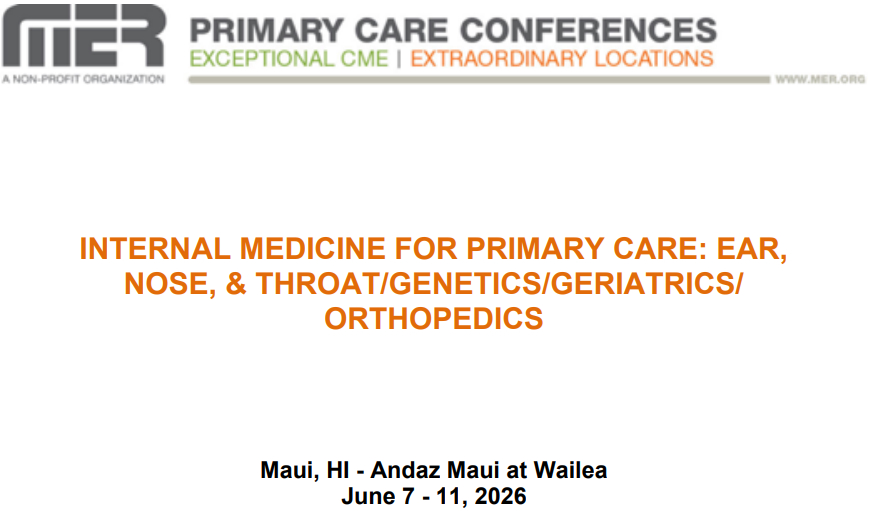
MER Primary Care Conferences Internal Medicine for Primary Care ENT Genetics Geri Ortho Jun 07-11, 2026
Original price was: $1,335.00.$130.00Current price is: $130.00.
MER Primary Care ENT Genetics Geri Ortho 2026 reviews ENT, genetics, geriatric care and orthopedic conditions.
Delivery Information: This Product is shared via google drive download link. Please use your correct Gmail address at checkout.
Please note: there are no CME points or certificate associated with this course.
Samples for Courses Can be found here: Free Samples Here!
MedicalAmboss File Scope: This listing summarizes the official educational program for reference. Provider registration, live participation, streaming access, CME or MOC credit, certificates, apps, accounts, and post-course access are not represented as included unless they are explicitly present in the listed store files. MedicalAmboss.
MER Primary Care ENT Genetics Geri Ortho 2026
Comprehensive Primary Care CME | ENT, Genetics, Geriatrics & Orthopedics
Stay up to date with practical, evidence-based approaches to common conditions encountered in primary care with MER Internal Medicine for Primary Care: Ear, Nose, & Throat/Genetics/Geriatrics/Orthopedics 2026.
Organized by Medical Education Resources (MER), this comprehensive primary care continuing medical education program provides clinically relevant updates across orthopedics, geriatrics, ENT, genetics, heart failure, hypertension, urinary symptoms, hearing disorders, sinusitis, and genetic counseling.
The conference will take place from June 7–11, 2026, at the Andaz Maui at Wailea in Maui, Hawaii.
Product Details
- Course: Internal Medicine for Primary Care: Ear, Nose, & Throat/Genetics/Geriatrics/Orthopedics
- Provider: Medical Education Resources (MER)
- Conference Dates: June 7–11, 2026
- Location: Maui, Hawaii
- Venue: Andaz Maui at Wailea
- Format: Educational Videos
- Language: English
- Educational Focus: Primary Care & Internal Medicine
- Learning Format: Expert Lectures, Discussion & Case-Based Learning
Course Overview
Primary care physicians frequently encounter patients with musculoskeletal complaints, ENT conditions, cardiovascular disease, geriatric concerns, urinary symptoms, and potentially hereditary disorders.
The MER Internal Medicine for Primary Care 2026 program provides a multidisciplinary review designed to strengthen clinical assessment, diagnosis, treatment planning, and referral decisions in everyday primary care practice.
The curriculum combines practical education in orthopedics, geriatrics, ENT, genetics, heart failure, hypertension, lower urinary tract symptoms, sinusitis, hearing loss, tinnitus, and genetic testing.
Discussion and case-based learning are incorporated to help clinicians translate evidence-based concepts into practical patient-care strategies.
What You’ll Learn
Participants will strengthen their knowledge of:
- Knee anatomy and function
- Hip, thigh, knee, and shoulder disorders
- Shoulder injuries
- Wrist, hand, and finger injuries
- Chronic foot and ankle injuries
- Foot and ankle pain syndromes
- Lower urinary tract symptoms (LUTS)
- Urinary incontinence
- Heart failure with reduced ejection fraction
- Heart failure with preserved ejection fraction
- Hypertension in younger adults
- Hypertension in older adults
- Neck masses
- ENT imaging and referral
- Sinusitis
- Allergic pathways
- Sensorineural hearing loss
- Conductive hearing loss
- Tinnitus
- Heritable conditions
- Genetic counseling
- Family history collection
- Karyotype testing
- Microarray testing
- Gene panels
- Whole-exome sequencing (WES)
- Whole-genome sequencing (WGS)
- Mitochondrial DNA (mtDNA)
Comprehensive Course Topics
Orthopedics & Musculoskeletal Medicine
Develop a practical approach to common orthopedic and musculoskeletal problems encountered in primary care.
Topics include:
- Knee anatomy and function
- Hip disorders
- Thigh disorders
- Knee disorders
- Shoulder disorders
- Shoulder injuries
- Wrist injuries
- Hand injuries
- Finger injuries
- Chronic foot injuries
- Chronic ankle injuries
- Foot pain syndromes
- Ankle pain syndromes
Knee, Hip & Shoulder Disorders
Review practical approaches to diagnosing and treating orthopedic problems involving the:
- Hip
- Thigh
- Knee
- Shoulder
The course emphasizes clinical assessment and treatment strategies applicable to primary care settings.
Foot & Ankle Conditions
Strengthen recognition and management of:
- Chronic foot injuries
- Chronic ankle injuries
- Foot pain syndromes
- Ankle pain syndromes
Shoulder, Wrist, Hand & Finger Injuries
Review the diagnosis and treatment of common upper-extremity injuries involving:
- Shoulder
- Wrist
- Hand
- Fingers
Geriatrics & Primary Care
The program addresses several issues frequently encountered when caring for older adults.
Topics include:
- Lower urinary tract symptoms
- Urinary incontinence
- Heart failure
- Hypertension
- Cardiovascular risk
- Age-related treatment considerations
- Evidence-based management strategies
Lower Urinary Tract Symptoms & Urinary Incontinence
Review common lower urinary tract symptoms (LUTS) that may progress to urinary incontinence.
Participants will learn approaches to:
- Recognize common LUTS
- Identify symptoms that may progress to urinary incontinence
- Initiate appropriate treatment options
- Incorporate urinary symptom management into primary care practice
Heart Failure
The course provides an evidence-based review of heart failure assessment and treatment.
Topics include:
- Heart failure with reduced ejection fraction (HFrEF)
- Heart failure with preserved ejection fraction (HFpEF)
- Clinical assessment
- Evidence-based treatment plans
- Collaboration with cardiology
- Case-based heart failure management
Case-Based Learning
Discussion and case-based learning help clinicians incorporate available heart failure treatment options into everyday clinical practice.
Hypertension
Review hypertension assessment and management across different age groups.
Topics include:
- Hypertension in younger adults
- Hypertension in older adults
- Cardiovascular risk
- Treatment goals
- Appropriate interventions
- Evidence-based management
- Case-based treatment decisions
ENT & Otolaryngology
Develop a practical approach to common ear, nose, and throat (ENT) problems encountered in primary care.
Topics include:
- Neck masses
- ENT imaging
- ENT referral
- Sinusitis
- Allergic pathways
- Sensorineural hearing loss
- Conductive hearing loss
- Tinnitus
Neck Mass Evaluation
Learn to identify patients presenting with a neck mass who may require additional evaluation.
The course addresses:
- When imaging may be necessary
- When referral to an ENT specialist is appropriate
- Incorporating clinical findings into referral decisions
Sinusitis & Upper-Airway Allergy
Review appropriate treatment approaches for sinusitis and the basic allergic pathways affecting the nasal and sinus regions.
Topics include:
- Systemic antimicrobial agents
- Topical antimicrobial agents
- Sinusitis treatment
- Allergic pathways
- Nasal allergy
- Sinus-related allergic conditions
Hearing Loss
Strengthen the ability to differentiate:
- Sensorineural hearing loss
- Conductive hearing loss
Understanding this distinction can support appropriate clinical evaluation and management.
Tinnitus
Review clinical approaches to tinnitus and identify appropriate management strategies for patients presenting with this common symptom.
Genetics & Genetic Medicine
The course introduces important genetic medicine concepts relevant to primary care.
Topics include:
- Heritable conditions
- Genetic red flags
- Adult versus pediatric phenotypes
- Genetic counseling
- Family history collection
- Informed consent
- Risk communication
- Genetic testing
Recognizing Heritable Conditions
Learn to identify red flags for hereditary disorders that may mimic common chronic diseases.
The program emphasizes:
- Recognition of potential inherited conditions
- Differences between adult and pediatric phenotypes
- Appropriate consideration of genetic evaluation
Genetic Counseling
Review practical approaches to genetic counseling in primary care.
Topics include:
- Efficient family history collection
- Informed consent
- Communication of genetic risk
- Patient counseling
- Selection of appropriate genetic testing
Genetic Testing Methods
Understand the differences between major genetic testing approaches, including:
- Karyotype
- Chromosomal microarray
- Gene panels
- Whole-exome sequencing (WES)
- Whole-genome sequencing (WGS)
- Mitochondrial DNA (mtDNA)
The program helps clinicians distinguish between these testing methods and understand their roles in evaluating potentially heritable conditions.
Learning Objectives
Upon completion of this program, participants should be better able to:
- Describe the anatomy and function of the knee joint.
- Diagnose and treat orthopedic problems involving the hip, thigh, knee, and shoulder.
- Recognize chronic injuries and pain syndromes affecting the foot and ankle.
- Diagnose and treat shoulder injuries.
- Diagnose and treat wrist, hand, and finger injuries.
- Review common lower urinary tract symptoms (LUTS) that may progress to urinary incontinence and initiate treatment options.
- Describe assessment and evidence-based treatment plans for heart failure with reduced and preserved ejection fraction in collaboration with cardiology.
- Utilize discussion and case-based learning to incorporate heart failure treatment options into clinical practice.
- Evaluate hypertension in younger and older adults, differentiate risks and treatment goals, and recommend appropriate interventions.
- Utilize discussion and case-based learning to further incorporate hypertension treatment options into practice.
- Identify when imaging and/or referral to an ENT specialist is necessary for patients presenting with a neck mass.
- Recommend appropriate systemic and/or topical antimicrobial agents for the treatment of sinusitis.
- Review basic allergic pathways affecting the body, with particular emphasis on the nasal and sinus regions.
- Differentiate between sensorineural and conductive hearing loss.
- Identify management approaches for tinnitus.
- Identify red flags for heritable conditions that mimic common chronic diseases and understand how adult and pediatric phenotypes differ.
- Implement genetic counseling using efficient family history collection, informed consent, and communication of risk.
- Distinguish between karyotype, microarray, gene panels, WES, WGS, and mtDNA.
Educational Highlights
- Primary Care Medicine
- Internal Medicine
- ENT
- Otolaryngology
- Genetics
- Genetic Counseling
- Geriatrics
- Orthopedics
- Musculoskeletal Medicine
- Heart Failure
- HFrEF
- HFpEF
- Hypertension
- Lower Urinary Tract Symptoms
- Urinary Incontinence
- Sinusitis
- Allergic Disease
- Hearing Loss
- Tinnitus
- Knee Disorders
- Shoulder Injuries
- Foot & Ankle Disorders
- Wrist & Hand Injuries
- Continuing Medical Education (CME)
Why Choose This Course?
The MER Internal Medicine for Primary Care: ENT/Genetics/Geriatrics/Orthopedics 2026 program provides a broad multidisciplinary update covering several high-frequency areas of primary care.
From orthopedic injuries and heart failure to ENT disorders, hypertension, urinary symptoms, genetic medicine, and hearing disorders, the program delivers clinically relevant educational content that can support improved diagnostic and treatment decisions.
Its combination of expert presentations, discussion, and case-based learning makes it a practical resource for clinicians seeking to update their knowledge across multiple specialties in one program.
Target Audience
This educational activity is designed for office-based primary care providers and other healthcare professionals seeking updates in primary care medicine.
Best For
- Internists
- Primary Care Physicians
- Otolaryngologists
- ENT Specialists
- Geneticists
- Geriatricians
- Orthopedists
Also Relevant For
- Family Medicine Physicians
- Nurse Practitioners
- Physician Assistants
- Other Healthcare Professionals Providing Primary Care
Who Should Take This Course?
This program is particularly useful for clinicians who:
- Manage common orthopedic and musculoskeletal complaints.
- Evaluate knee, shoulder, hip, foot, ankle, wrist, and hand conditions.
- Manage hypertension in younger and older adults.
- Evaluate and treat patients with heart failure.
- Encounter neck masses and common ENT complaints.
- Treat sinusitis and upper-airway allergic conditions.
- Evaluate hearing loss and tinnitus.
- Manage lower urinary tract symptoms and urinary incontinence.
- Need to recognize potential hereditary conditions.
- Want to improve their understanding of genetic counseling.
- Need to understand the differences between major genetic testing methods.
- Seek a broad multidisciplinary primary care update.
Course Benefits
By reviewing this program, learners can strengthen their approach to:
- Orthopedic diagnosis and treatment
- Musculoskeletal assessment
- Heart failure management
- Hypertension management
- ENT evaluation
- Sinusitis management
- Hearing loss assessment
- Tinnitus management
- Lower urinary tract symptoms
- Urinary incontinence
- Genetic risk assessment
- Genetic counseling
- Genetic testing
- Geriatric primary care
- Evidence-based clinical decision-making
4. Topics
Sunday, June 7, 2026
-
Orthopedics – The Knee: Anatomy, Common Injuries, and Exam Techniques: ACL, meniscus, MRI; common sports injuries; osteoarthritis and hyaluronan; bursitis: prepatellar, pesanserine; baker’s cyst; joint injection/X-ray interpretation; pediatrics.
-
Orthopedics – Hip and Thigh: Emphasizing the tools, physical diagnostic techniques and basic investigations available to the primary care practitioner, a practical approach to the undifferentiated hip problem will be reviewed. Diagnostic triage, historical clues and physical examination pearls pertaining to hip conditions will be covered, and evidence-based management.
-
Orthopedics – Ankle and Foot: This presentation will address a series of common acute and chronic injuries and pain syndromes to the foot and ankle as they would present in the primary care setting. The focus will be on developing a working differential diagnosis based on the historical mechanism of injury and exam findings.
Monday, June 8, 2026
-
Geriatrics – Urological Disorders in the Older Adult: Review common lower urinary tract symptoms (LUTS) in older adults that may progress to incontinence; Practical approaches to differential diagnoses and management of Stress Incontinence, Overflow Incontinence, and Overactive Bladder (OAB), leading to Urge Incontinence.
-
Geriatrics – Heart Failure in Older Adults: Recognition of the high mortality associated with heart failure; Understanding how to diagnose heart failure and the difference between reduced ejection fraction and preserved ejection fraction heart failure; Evidence based treatments available for heart failure.
-
Geriatrics – Heart Failure Discussion and Q&A: Interactive review of the principles of heart failure diagnosis and treatment in older adults, and audience questions further clarifying the topic.
-
Orthopedics – The Shoulder: Anatomy, Common Injuries, and Exam Techniques: Rotator cuff syndrome; impingement, frozen shoulder; subacromail bursitis; bicipital tendonitis; A-C joint disease.
-
Orthopedics – Wrist, Hand, and Fingers: Carpal tunnel, CMC arthritis thumb, ganglion cyst, trigger finger, de Quervains disease.
Tuesday, June 9, 2026
-
ENT – Evaluation of the Neck Mass: Patients presenting with masses in the neck are challenging and worrisome. The diagnostic and therapeutic process is described. A method for evaluating the mass, guidance on when imaging studies are indicated, and when immediate or routine referral to ENT becomes appropriate is discussed.
-
ENT – Antimicrobial Therapy in Treating Sinusitis: Symptoms, signs and examination findings helpful in diagnosing sinusitis are outlined. When to use systemic and topical agents as well as emerging resistance to these agents is discussed. Imaging studies and proper referral to specialists is described with clarity.
-
ENT – Allergic Rhinitis: The lecture will focus on a review of the basic allergic pathways that affect the body. Special emphasis will be given to the nasal and sinus regions, with discussion to include diagnostic testing and modes of treatment, including avoidance, pharmacotherapy and immunotherapy.
-
Geriatrics – Controversies in the Management of Hypertension in Older Adults: Best evidence for treatment goals for hypertension in diabetics and those with previous stroke; Controversial evidence for the various guidelines for diagnosing and treating hypertension in older adults; Best evidence-based medications for hypertension.
-
Geriatrics – Hypertension Discussion and Q&A: Interactive review of the principles of hypertension diagnosis and treatment in older adults, and audience questions further clarifying the topic.
Wednesday, June 10, 2026
-
Genetics – Recognizing Undiagnosed Genetic Disease in Adults: Identification of clinical patterns and multisystem red flags suggestive of an underlying genetic disorder; Key adult and pediatric manifestations of selected genetic conditions; Appropriate referral and testing pathways to reduce diagnostic delay.
-
Genetics – Practical Genetic Counseling for the Busy Clinician: Putting in place a system to collect a clinically meaningful three-generation family history in less than 5 minutes; Essential elements of informed consent for genetic testing; Strategies to communicate genetic risk and testing implications clearly to patients of varying health literacy levels.
-
Genetics – The Genetic Rosetta Stone: Understanding Test Types and When to Use Them: Major genetic test types and their appropriate clinical indications; The diagnostic yield and limitations of each modality for common primary care presentations; Appropriate tests based on patient history, urgency, and suspected phenotype.
-
ENT – A Primary Care Approach to Sudden Hearing Loss: When a patient presents with sudden hearing loss, accurate differentiation of sensorineural versus conductive loss is essential. Techniques to make that differentiation, testing and treatment strategies will be discussed; Urgent treatment and when to render for audiometric testing and ENT referral will be outlined.
-
ENT – Tinnitus: Primary care approach to proper diagnosis and treatment of common ringing in the ear; includes latest advancements in treatment approaches.
Thursday, June 11, 2026
-
Genetics – Genetic Testing 2.0: Polygenic Risk Scores & Direct-to-Consumer Results: Discussion of polygenic risk scores, how they are developed and what they measure; The clinical utility and limitations of PRS in primary care; Strategies to counsel patients who present with direct-to-consumer genetic reports.
-
Genetics – Variants and VUS: Managing Uncertainty in Genetic Results: Discussion of the ACMG/AMP variant classification framework in simple clinical language; Differentiating VUS from actionable findings and outlining appropriate clinical responses; Plans for reanalysis, follow-up testing, and family studies when indicated.
Related products
Internal Medicine

Cardiology

Anesthesiology & pain medicine

Internal Medicine

USMLE / kaplan and Board Review
Uworld USMLE COMLEX Level 1 Qbank, Updated Jan 2023, System- and Subject-wise (PDF)
Critical Care - Emergency medicine
2022 UPDATES IN THERAPEUTICS: CRITICAL CARE PHARMACY PREPARATORY REVIEW AND RECERTIFICATION COURSE

Critical Care - Emergency medicine
Internal Medicine